
Artificial intelligence (AI) is becoming an increasingly important part of modern medicine. In neurosurgery, researchers and healthcare professionals are exploring how AI can support the diagnosis, planning, and management of complex brain and spine conditions.

AI is not intended to replace neurosurgeons. Instead, its potential role is to provide additional information that can support clinical decision-making.
How Is AI Being Used in Medical Imaging?
Brain and spine conditions often require detailed imaging such as CT scans and MRI scans. AI-based systems can analyse medical images and identify patterns that may require closer attention.
Research is exploring the use of AI for:
- Detecting abnormalities in brain scans
- Analysing brain and spine MRI images
- Identifying certain types of tumors
- Supporting stroke assessment
- Evaluating spinal conditions
- Comparing imaging findings over time
These technologies may help clinicians process large amounts of imaging information more efficiently.
AI and Brain Tumor Care
Brain tumors can vary significantly in their location, size, type, and biological characteristics.
Researchers are investigating whether AI can help analyse imaging data and other clinical information to better characterize tumors and support treatment planning.
AI may potentially assist in identifying patterns that are difficult to assess through conventional methods alone. However, clinical decisions still require expert medical assessment.
AI in Surgical Planning
Neurosurgery often involves working around critical structures of the brain, spinal cord, and nerves.
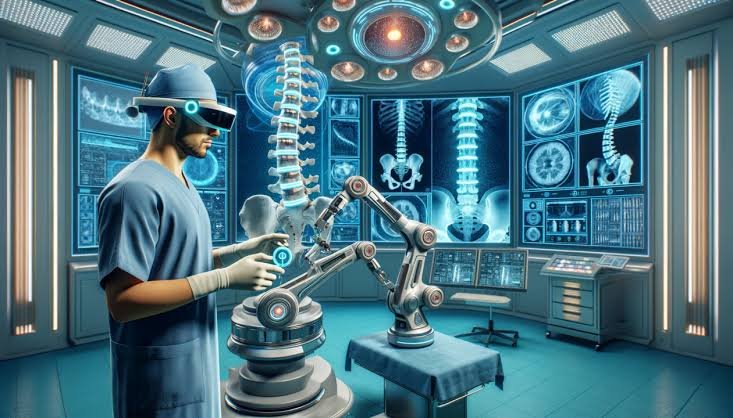
Advanced computer-based technologies can help doctors visualize anatomy and plan complex procedures. AI may contribute to this process by analysing patient-specific information and assisting with surgical planning.
The ultimate goal is to make procedures more precise while protecting important neurological structures.
AI and Spine Surgery
AI research is also expanding in the field of spine care.
Potential applications include analysing spinal imaging, identifying patterns associated with certain spine conditions, predicting outcomes, and assisting in treatment planning.
These technologies are still developing, and their usefulness can vary depending on the condition, data quality, and clinical setting.
Can AI Replace a Neurosurgeon?
No.
AI systems analyse data and generate predictions or suggestions, but they do not replace clinical examination, professional judgment, communication with the patient, or responsibility for treatment decisions.
A neurosurgeon considers multiple factors, including symptoms, neurological examination, medical history, imaging, overall health, and the patient’s individual circumstances.
AI should therefore be viewed as a potential clinical support tool, rather than a replacement for medical expertise.
Challenges and Limitations
Despite its potential, AI in healthcare also presents important challenges.
These include:
- Accuracy and reliability
- Quality of medical data
- Patient privacy
- Bias in datasets
- Integration into clinical workflows
- Need for appropriate validation
- Understanding how AI reaches certain conclusions
A technology that performs well in one hospital or dataset may not necessarily perform equally well in every clinical environment.
What Could the Future Look Like?
As research continues, AI may become increasingly integrated into medical imaging, clinical decision support, surgical planning, rehabilitation, and personalized healthcare.
The most valuable approach is likely to be a combination of advanced technology and experienced medical professionals.
Final Thoughts
Artificial intelligence has significant potential to support the future of brain and spine care. However, medical AI must be carefully validated and responsibly implemented before it can be relied upon for important clinical decisions.
The future of neurosurgery is likely to involve collaboration between medical expertise, advanced imaging, data science, and emerging technologies — with patient safety remaining the priority.
Category: Research & Updates
Suggested Tags: Medical Research, Neurosurgery, Artificial Intelligence, Brain Health, Spine Care, Medical Technology